

The Goldilocks Zone 🛌
Finding the sweet spot for growth

I enjoy doing Sudoku puzzles (crosswords not so much). I used to be a middle school math teacher, and to me, there is something soothing about the numbers all working out. So when I saw that a daily, printed Sudoku puzzle was available on our cruise in March, I eagerly grabbed a copy. My 17 year old and I sat down to work on it, something we used to do together when he was younger. Yet, no matter how hard we tried, we couldn’t solve the puzzle. Thinking it was a fluke, we tried again the next day. Nope. We still couldn’t solve it. So we gave up, to my great disappointment, as I was hoping this was something we could share together (it gets harder to find common interests as he gets older).
Evidence 🔎
Giving up. That is what happens when things are hard. And if they are too easy, we get bored. Research attests to this. Vygotsky wrote about the “zone of proximal development:” that sweet spot where we are able to grow, with support.
He said schools have things backwards: they test kids on what they already know, but that doesn’t show us what they are capable of learning. We should instead test kids on what they are capable of doing, with help. That seems like cheating to most school leaders. It is, if you are testing recall or remembering. But if you want to know how to help someone learn or grow, you need to assess their present level of capability: their growth zone.
If you try to teach someone something, and they can’t get it, even with help, then right now, that skill or concept is outside their learning zone. For now. Focusing here leads to frustration.
If you teach someone something they already know, that lies in their comfort zone. This doesn’t lead to growth; it leads to boredom.
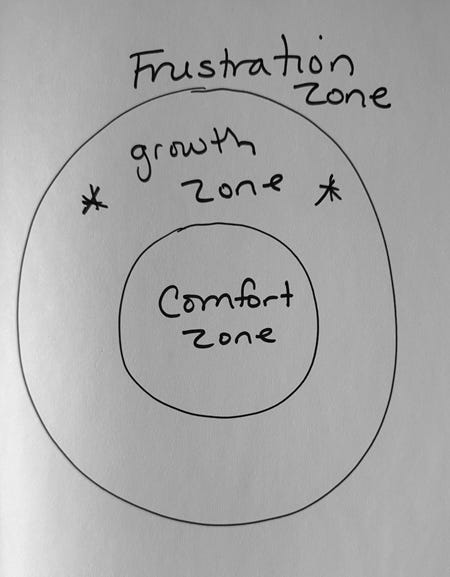
The Sudoku was too hard for me. Even with my kid’s help and the use of the typical tricks I use, I couldn’t solve it. It was in our frustration zone, so we did what most people do when frustrated: We gave up.
What I needed was more advanced strategies for solving difficult Sudokus1 or coaching by someone better at solving these harder puzzles. Or an easier puzzle (but not too easy!).
What I needed was a puzzle that was just right for me: not too hard, not too easy. That is what I call the Goldilocks Zone. (It’s a lot easier to remember that zone of proximal development!)
The Sweet Spot 🍭
Life presents growth opportunities. If they are too hard to accomplish on your own, find help or new strategies. You want a little bit of stretch and challenge, but not frustration.
Also, to grow, we need to embrace a bit of discomfort to grow. Not too much. Not alone. But enough to stretch us out of our comfort zone.
The Sandbox: Try This☑️
Make finding the sweet spot between frustration and comfort, the Goldilocks Zone, a goal when you are trying something new. Whether it’s adopting a new habit or learning something new, you are allowed to make something your own. Listen to your inner wisdom and don’t be afraid to customize something to fit you. If the plan involves something serious, like a medical protocol, or with high-stakes consequences, like a graduate degree, be sure to talk to your doctor or supervisor to get them to sign off on the plan. But don’t be afraid to ask.
✨Joy✨ Highlights of the Week💫
I have had so much fun on Substack this week meeting new people.
I am really enjoying Dr. Heather England’s A Midlife Reckoning Substack. She shared a fantastic experiment recently that I’m going to try to remember to use with my teenager:
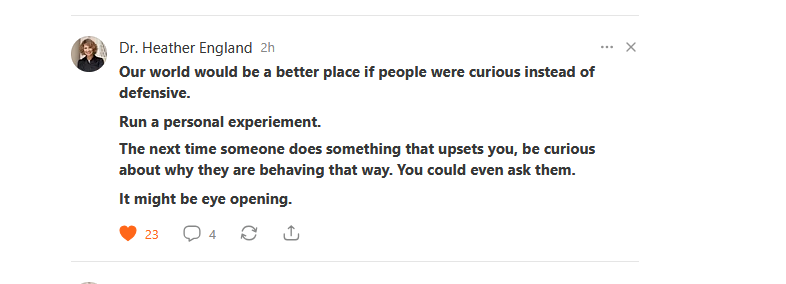
Curiosity over defensiveness. Such a critical mindset shift.
It’s hard to remember to do in the heat of the moment, which is why I need to get back to finishing Dr. Kelly Flanagan’s new book, The Road Less Triggered. I want to give a copy to all of my friends .

Today marks my first official newsletter in this new format. I would love to hear what you think of the approach.
And if you haven’t subscribed yet, be sure to do so. More goodies are coming, but only for subscribers. It’s free and easy to do. Just click the link below.
PS. I found out later that this cruise line’s Sudokus weren’t just hard, they were described as “killer” puzzles. No wonder we struggled!